

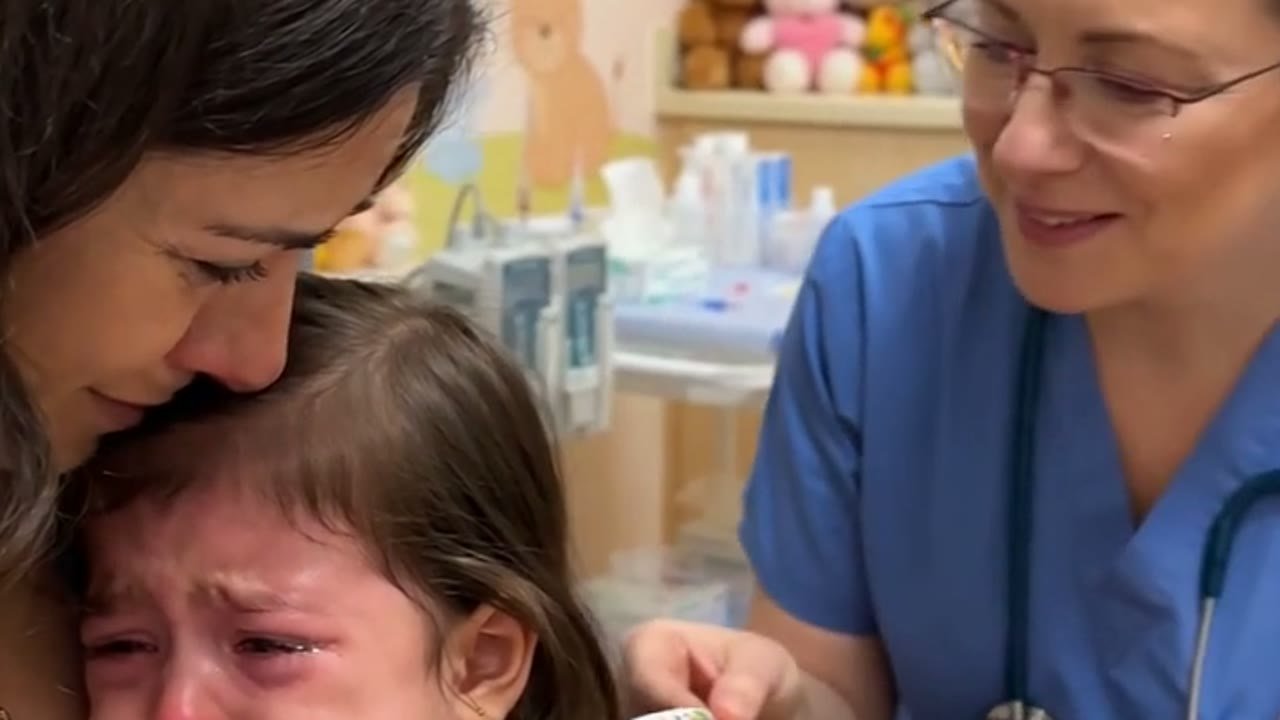
Bravery does not always look the way we expect it to look. Sometimes it does not look calm at all. Sometimes it looks like a small child in tears, holding on to her mother as tightly as she can, in a bright pediatric room, facing something she is frightened of — and getting through it anyway, one second at a time, without ever being left alone.
That is the whole story of this short video, and it is also why it stays with you. There is no big speech and no dramatic rescue. There is a mother, a child, and a nurse. There is fear, there is comfort, and there is the quiet moment at the end when the crying slows down and pride takes its place.
The video begins inside a pediatric vaccination room that has clearly been made to feel less frightening for children. The walls are soft and colorful, decorated with balloons, stars, a giraffe, a teddy bear, and a bunny. There are cheerful posters, small toys on a shelf, and a trolley with the supplies the nurse will need. It is, in every way, a room designed for children. But for the little girl at the center of the video, none of that matters at first, because she already knows why she is there.
She is about three years old, with light brown curls tied back with a small pink clip, and she is wearing a pink T-shirt with a unicorn on it. She sits on her mother’s lap, exactly where she will stay for the entire video. Her mother, a woman with long dark hair in a blue floral dress, holds her close with both arms. In the background, the nurse — a woman with curly reddish-brown hair and glasses, wearing blue medical scrubs and a stethoscope — quietly prepares what she needs at the trolley.
Then the child notices what is coming, and the fear arrives all at once.
Her face crumples. Her eyes fill, then spill over. She clings to her mother, gripping her dress with one small hand, and cries out the words almost any parent has heard in a room like this: “No, Mommy! I don’t want the shot! Please!”
It is not a tantrum. It is a small child’s honest fear, expressed in the only way she knows how. She does not try to be brave. She does not pretend to be fine. She simply holds on to the person she trusts most in the world and says, out loud, that she is scared.
Her mother does not argue with that fear, and she does not dismiss it. She does something much more important. She stays.
In the next part of the video, the camera moves closer, and the mother’s response becomes the heart of the scene. She gathers her daughter in, presses her face gently against the child’s head, and holds her little hand firmly in her own. She wipes at the tears, keeps her arm wrapped around her, and speaks to her softly: “It’s okay, sweetheart. I’m right here. I’ll hold your hand the whole time.”
The child continues to cry. She shakes her head. She buries her face against her mother’s shoulder, hiding there as if that one familiar place could make the moment pass without touching her. Her small hand stays locked in her mother’s hand the whole time. Nothing about her fear is rushed or corrected. She is allowed to be frightened, and she is never for a single moment frightened by herself.
The nurse, meanwhile, does her part with the same kind of patience. She does not loom over the child or hurry the moment along. She comes down to the child’s level, smiles warmly, and calmly lets her know that it will be very quick. There is no tension in her manner and nothing frightening in the way she works. She is unhurried, gentle, and professional, and that calm matters. For a child of three, an adult’s calm face is information: it tells her that the grown-ups around her are not alarmed, even if she is.
Then comes the part the little girl has been dreading.
Held securely on her mother’s lap, with her hand still in her mother’s hand, she receives the vaccine in her upper arm. It is over quickly, just as the nurse said it would be. The child cries hard for a moment and squeezes her mother’s hand tightly — the natural reaction of a small child to a sharp, unfamiliar second of discomfort. Her mother holds the spot gently and keeps her close. The nurse finishes, puts everything safely away, and turns back to her with a smile and the words the little girl has earned: “All done, sweetheart! You did it!”
And she did. That is worth pausing on, because it is the real subject of the video. She did the thing she was afraid of. Not happily, not calmly, and not without tears — but she did it, with help, and she came out the other side.
The final part of the video is the slowest and the most tender. The crying does not stop all at once. It softens, in stages, into sniffling. The child’s eyes are wet and red, her cheeks flushed, and she looks up at the nurse with a watery, uncertain expression, as if she is only just beginning to understand that the worst part is already behind her.
Her mother pulls her into a proper hug and kisses her on the head, holding her as if she never intends to let go first. Then the nurse offers her a small, colorful sticker, bright with little bears and balloons, the kind of reward that might look tiny to an adult and enormous to a three-year-old. The child takes it and holds it in her hand. It is a small thing, but in that moment it is not really a sticker at all. It is proof. It is something she can hold that says she got through the thing she thought she could not face.
In the final close-up, her tearful face gradually gives way to a tiny, shy little smile through the tears, as she hugs her mother even tighter and her mother whispers the line that closes the video: “I’m so proud of you.”
It is the right ending, because it names what actually happened in that room. The pride is not there because the child did not cry. She cried a great deal, and the video never pretends otherwise. The pride is there because she stayed, she held on, and she finished something hard while frightened — and because the adults around her understood that this is exactly what courage looks like at three years old.
That is why a video this simple can move so many people, especially parents. Almost every family knows this room. Almost every parent knows the feeling of holding a child who is scared of something that will be over in seconds but feels endless to them, and of wishing you could take the fear away while knowing that the best you can actually do is be the steady presence they hold on to. Almost every parent also knows the relief of the moment just after, when the tears start to slow and your child looks at you, exhausted and tear-stained, and you realize they are a little bit proud of themselves too.
The video does not need anything more than that. No name is given for the child, the mother, the nurse, or the clinic, and none is needed. A colorful room, a mother’s hand held tightly from beginning to end, a nurse who worked gently and quickly, a sticker earned honestly, and four quiet words at the end — “I’m so proud of you” — are enough.
She came into that room afraid, and she cried through the hardest part of it. But she did it in her mother’s arms, and she left the moment with a sticker in her hand and a small smile through her tears.
That is what it means to be the little brave one.