

He did not shout. He did not beg. He did not make a scene. He simply opened the door of an elegant restaurant on a busy city street, walked in slowly, and asked, politely, if he could sit down and get something to eat.
That is where the video begins, and that is why it stays with you long after it ends.
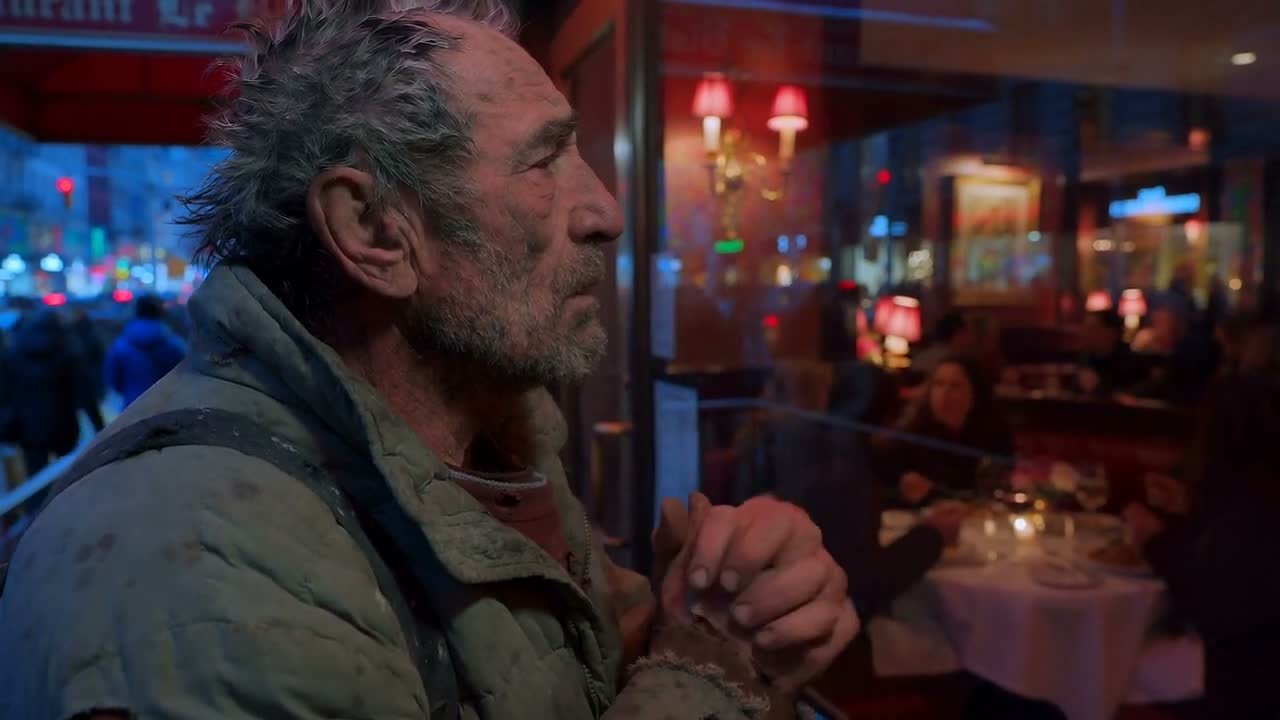
The man in the video is around 55 years old. He wears old, worn-out clothes, a faded jacket, and scuffed shoes. His face shows exhaustion and hardship, the kind of exhaustion that does not come from one bad day, but from many hard years. And yet, the way he behaves is quiet, respectful, and full of dignity. He does not demand anything. He only asks.
Inside, the restaurant is warm and beautiful. The lighting is soft, the tables are arranged with care, and customers are enjoying their meals, talking, laughing, and living their ordinary, comfortable evening. For a moment, as the man looks around, you can see what he sees: warmth, food, safety, and a place to belong, even for a little while.
He walks to the reception desk and speaks quietly. He asks if he can sit down and get something to eat. It is a simple request, spoken in a calm voice, by a man who knows exactly how he looks and what the answer might be, but who asks anyway, because hunger does not wait for pride.
The manager looks at him, notices his appearance, and answers calmly. There is no shouting, no threatening, no touching, and no insult. The manager speaks politely and gently gestures toward the exit, explaining that he cannot stay inside.
It is a rejection, but it is not a violent one. And that is what makes the scene so powerful and so painful at the same time. No one is cruel in the obvious, dramatic way. No one raises a hand. And yet, a human being is still turned away, still left outside, still hungry.
The man lowers his eyes. He nods quietly. And he whispers the two words that break your heart more than any argument ever could: I understand.
He does not argue. He does not plead. He does not make the people around him uncomfortable on purpose. He simply understands, because he has understood this many times before. He turns around slowly and walks back toward the door, past tables full of food, past people who are eating, talking, and looking away.
A few customers notice what is happening. Most continue eating, as if nothing has changed. One customer looks at him briefly, with sympathy in their eyes, as if they want to do something but do not know what to do. Another avoids eye contact altogether, staring down at their plate, as if not seeing him will make the moment go away.
That, too, is part of the story. It is not only about the man and the manager. It is about all of us, and the small choices we make when we see someone in need: to look, to look away, to feel sympathy, or to pretend we did not notice.
Outside, the contrast becomes even sharper.
The man steps out into the cold evening air. Behind him, through the glass, the restaurant glows warm and golden. Inside, people are still eating, still laughing, still comfortable. Outside, he stands alone on the sidewalk, in the cold, looking through the window at a world he was just asked to leave.
He gently rubs his hands together to keep warm. He takes a deep breath, as if he is gathering the strength to keep going. And then he walks away, with his head lowered, down the busy city street, past lights and windows and people who will never know his name.
No one follows him. No one calls him back. The street keeps moving, the restaurant keeps serving, and life goes on, as if his quiet exit was nothing at all.
But it was not nothing. It was everything.
This video is not about blaming one manager, or one restaurant, or the customers inside. It is about a much bigger question, one that affects every city in the world: what do we do with people who have nothing, when they ask, politely, for something as simple as a meal and a place to sit?
It is about poverty, but it is also about dignity. The man in the video never loses his dignity, even when he is turned away. He behaves with more grace, patience, and respect than many people would in his situation. He does not lose his temper. He does not lose his humanity. He simply says, I understand, and walks away.
And it is about compassion. Compassion is not always a big, dramatic act. Sometimes it is a look, a kind word, a meal offered without judgement, or simply the decision not to look away. The customer who looks at him with sympathy shows us that compassion is still there, even in a moment of rejection. The customer who avoids eye contact shows us how easy it is to lose it.
The most powerful part of the video is its silence. There is no dramatic music telling you how to feel. There is no narrator explaining the message. There are only real, human moments: a tired face, a polite question, a calm refusal, a whispered answer, cold hands rubbed together, and a man walking away alone.
In those moments, the video asks us to think about our own lives. When was the last time we truly saw someone who was struggling? When was the last time we offered help, instead of looking away? And what kind of society do we want to be, if a polite man asking for food is met only with a gentle gesture toward the door?
Homelessness is often talked about in numbers, in statistics, and in policies. This video reminds us that behind every number is a person, with a face, a story, and a dignity that does not disappear just because they have lost a home.
He is not asking for luxury. He is not asking for pity. He is asking for something to eat, and a place to sit down, like anyone else.
And when he is told no, he does not hate the people inside. He understands. That understanding, quiet and heartbreaking, is the most powerful message of all.
It challenges us to do better. To see people, not problems. To offer kindness, not just politeness. To remember that a warm meal, a kind word, or a moment of genuine attention can mean more to someone than we will ever know.
The next time you are sitting in a warm restaurant, enjoying a meal with people you love, remember the man outside the window. Remember his polite voice, his lowered eyes, and his whispered words: I understand.
And ask yourself, honestly: do we understand him, too?